Hotel, Restaurant and Catering Supply Product Families: software delivery, marketplace operations is a product-family article, not a country-promotion article. It asks what a buyer should define before an RFQ so that Turkish suppliers answer the same commercial and technical question.
For Hotel, Restaurant and Catering Supply, the dangerous shortcut is to search a broad category, collect quick prices and decide too early. The stronger method is to split the category into product families, standards, evidence triggers and buyer risks before price comparison begins.
Product families that need separate RFQs
Each product family below may need different documents, tolerances, labels, tests, packaging and logistics rules. Putting them in one vague RFQ usually produces non-comparable quotations.
| Product family | Evidence trigger | Standards or compliance trigger | Buyer risk |
|---|---|---|---|
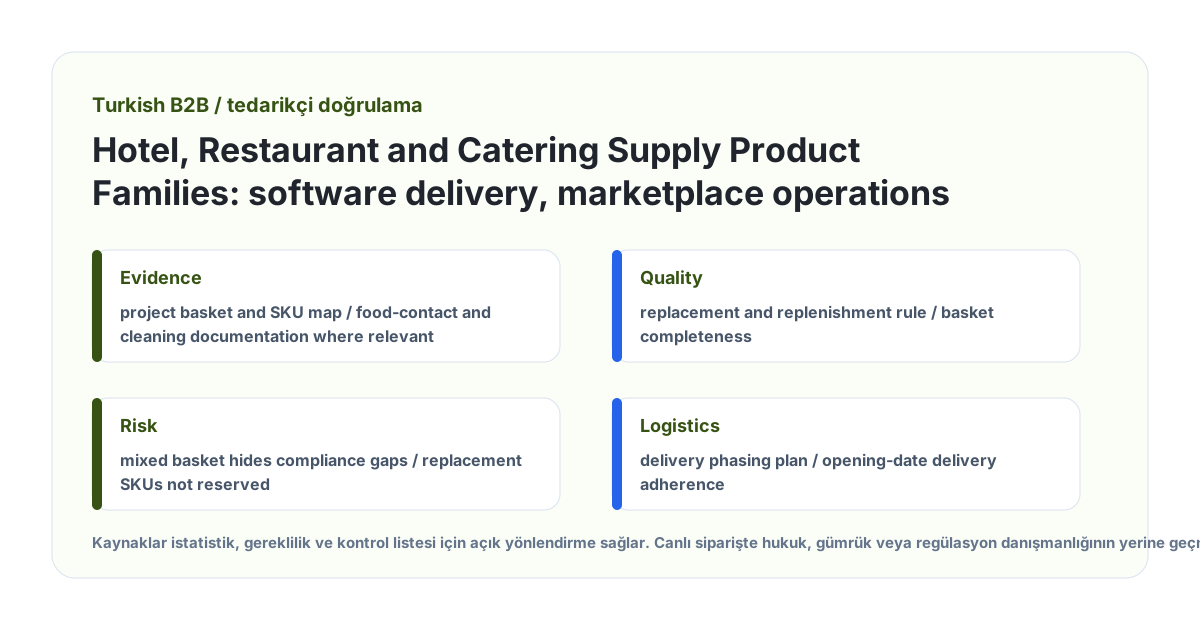
| software delivery | project basket and SKU map | data security | mixed basket hides compliance gaps |
| marketplace operations | food-contact and cleaning documentation where relevant | IP ownership | replacement SKUs not reserved |
| fulfillment support | replacement and replenishment rule | service continuity | project phasing not tied to opening date |
| HoReCa procurement bundles | delivery phasing plan | product content rights | only a catalog is shared when production evidence is requested |
| B2B service workflows | statement of work | customer support escalation | the supplier avoids naming the production site |
How open sources should be used
Open sources are useful when they improve the buyer's questions. They should not be used to pad an article with generic claims. A public source should either confirm national context, identify a product requirement, help with HS-level research, or improve the due-diligence checklist.
| Source type | Use it for | Do not use it for |
|---|---|---|
| Official statistics | Market and production context. | Claiming that a specific supplier is qualified. |
| Exporter association pages | Sector language, fair context and association route planning. | Copying member descriptions or treating membership as verification. |
| Government product guidance | Label, safety, customs and product-requirement questions. | Replacing legal advice for a live shipment. |
| Open trade datasets | HS-level demand and destination-market checks. | Final customs classification without broker/importer validation. |
| Municipal open data | Logistics, infrastructure and visit-planning context. | Product quality, compliance or supplier approval. |
Buyer specification notes
The specification should translate the product family into measurable fields. This is where many supplier conversations become useful or fail. A serious buyer should avoid asking for "best price" until these notes are written.
- statement of work
- SLA
- access-control map
- data-processing terms
- change-request process
- legal entity and production-site confirmation
- recent export document sample with sensitive prices removed
- product specification sheet
- data security
- IP ownership
- service continuity
- product content rights
Claims that need evidence
Supplier claims are not automatically wrong; they are simply incomplete until linked to a document, product, site, model, batch, formula, lot, drawing, carton or shipment. The buyer should ask for proof at the point where the claim changes the purchasing decision.
| Claim type | Evidence to request | Decision note |
|---|---|---|
| Export-ready | Recent export document sample with sensitive prices removed. | Useful only if the destination route and document type are relevant. |
| Certified or compliant | data security; IP ownership; service continuity | Check scope, product, model, site and expiry before relying on it. |
| Private label capable | Private label works only when formula, artwork, tooling, mold, pattern, label or design ownership is written before sampling. | Ownership and change-control rules must be written before sampling. |
| Stable quality | acceptance criteria; issue response SLA; repository or inventory reconciliation; continuity plan test | Ask how deviations are recorded and who closes corrective action. |
RFQ questions by product family
The following questions are designed to force comparable answers. If a supplier cannot answer them, the buyer may still continue the conversation, but the candidate should not be ranked on price yet.
- Which exact software delivery specification are you quoting, and what changes price?
- Which evidence can you share for project basket and SKU map, food-contact and cleaning documentation where relevant, replacement and replenishment rule?
- Which destination-market rules affect labels, instructions, claims, safety or documentation?
- Which parameter is checked during production, not only at final inspection?
- Which packaging, pallet, carton, barcode or document field would stop shipment if wrong?
Risk notes before first order
The first order should not test every possible SKU. It should test the highest-risk proof points while keeping scope narrow enough to manage. For this category, buyer risk is usually concentrated in specification drift, document scope, packaging assumptions and who owns correction when a deviation appears.
- mixed basket hides compliance gaps
- replacement SKUs not reserved
- project phasing not tied to opening date
- only a catalog is shared when production evidence is requested
- the supplier avoids naming the production site
- price changes when documentation is requested
- sample approval has no written rule for bulk production
- company and bank-detail verification
- deposit tied to approved sample and document file
- balance payment tied to inspection or shipment milestone
- change-order approval before extra cost
What to publish, what to keep internal
Public-facing articles should cite official/open sources and original interpretation. Internal buyer files may include supplier quotations, audit notes, private emails and licensed reports, but those should not be copied into published content. The article should teach the sourcing method; the private file should store commercial proof.
| Material | Public article use | Buyer file use |
|---|---|---|
| Official/open data | Cite and interpret with source links. | Use as background for category decisions. |
| Supplier documents | Describe the evidence type without exposing confidential details. | Store current files and score them. |
| Licensed reports | Do not reproduce unless license allows. | Use internally if properly licensed. |
| Directory text | Do not copy. | Use only as a lead to verify directly. |
Next step
After the product-family notes are written, move to Hotel, Restaurant and Catering Supply in Turkiye: B2B Potential Map for sector context and Hotel, Restaurant and Catering Supply in Turkiye: Supplier Shortlist and Verification for supplier verification. A supplier should not enter commercial negotiation until the product family, evidence trigger and first-order control are visible.
Buyer quality gate before action
Before using this Hotel, Restaurant and Catering Supply article as an RFQ or supplier file, check that every public-source note has been converted into a buyer decision, not copied as filler.
| Step | Evidence before price | Release rule |
|---|---|---|
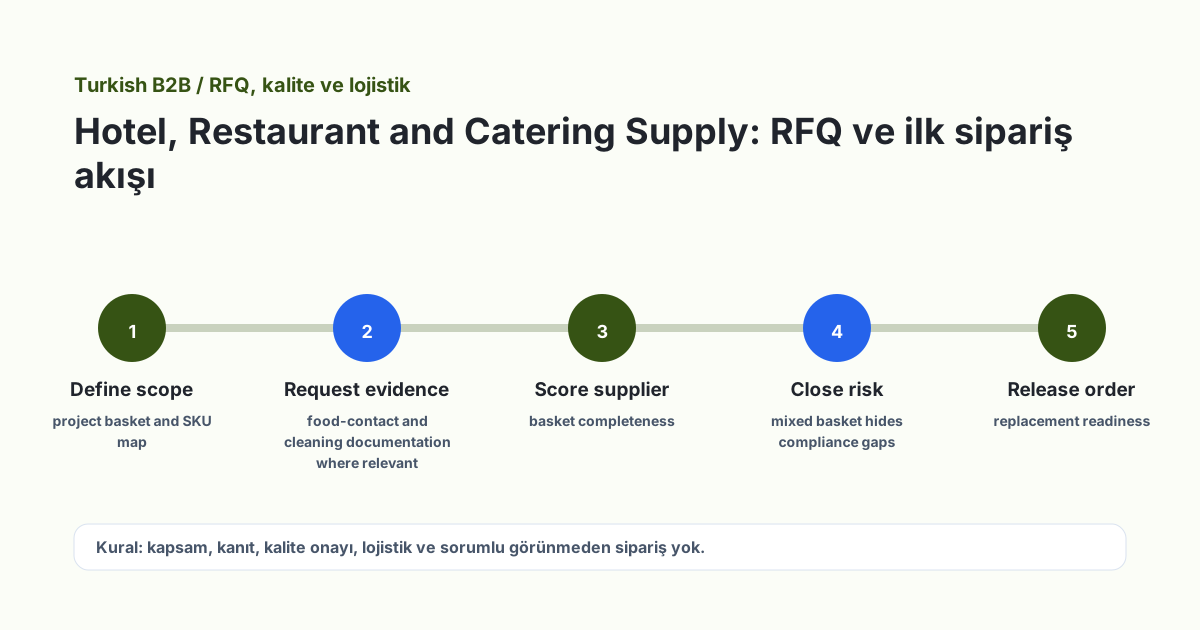
| What buyers should define | Hotel, Restaurant and Catering Supply: software delivery; marketplace operations; fulfillment support; HoReCa procurement bundles | Start with product family, destination market, volume band, required evidence, packaging, Incoterm, payment milestones and order-release rule before comparing prices. |
| Evidence before price | project basket and SKU map; food-contact and cleaning documentation where relevant; replacement and replenishment rule; delivery phasing plan; statement of work | Request product-specific evidence: production site, specification, sample approval, quality records, packaging plan, export document example and corrective-action owner. |
| Buyer risks to control | mixed basket hides compliance gaps; replacement SKUs not reserved; project phasing not tied to opening date; only a catalog is shared when production evidence is requested; the supplier avoids naming the production site | Control vague specification, hidden production responsibility, sample-to-bulk drift, weak packaging, missing documents and unverified payment details. |
| RFQ and first-order workflow | For Hotel, Restaurant and Catering Supply, frame the first order as a controlled product and standards notes pilot: start with software delivery, define release evidence, keep logistics assumptions visible and review basket completeness before repeat volume. | Rule: no order before scope, evidence, quality release, logistics and owner are visible. |
Hotel, Restaurant and Catering Supply supplier action
Use the guide as the buyer file, then request a shortlist or submit an RFQ with the evidence already defined: project basket and SKU map, food-contact and cleaning documentation where relevant, replacement and replenishment rule.
FAQ
Why split Hotel, Restaurant and Catering Supply into product families?
Different product families can require different standards, labels, documents, packaging and inspection rules. A broad RFQ creates non-comparable prices and hides risk.
Which source types should be used for product-risk notes?
Use official statistics for context, government guidance for requirements, open trade datasets for HS-level checks and exporter associations for sector orientation. Do not copy directory text or closed report prose.
What claims need proof before RFQ?
Claims such as export-ready, certified, private-label capable or stable quality should be linked to documents, product scope, site, batch, model, formula or shipment evidence.
What should be kept out of public articles?
Do not publish supplier confidential documents, copied directory descriptions, private emails or licensed market-report content unless the license explicitly allows it. Keep those materials in the internal buyer file.
Related buyer paths across the network
Official and open sources
Hotel, Restaurant and Catering Supply Product Families: software delivery, marketplace operations is original. It does not copy competitor websites, closed market reports or supplier-directory prose. The sources below are used as official or open references for Hotel, Restaurant and Catering Supply interpretation and checklist design.
For the product and standards notes angle, these links support national context, product-requirement thinking and verification workflow design. They do not replace buyer-side legal, customs or regulatory advice for a live Hotel, Restaurant and Catering Supply order.
- World Integrated Trade Solution - UN Comtrade accessOpen trade-data access point for HS-level import/export comparison.
- World Bank Logistics Performance IndexOpen/public logistics-performance reference for shipment and customs planning.
- FDA - Food Contact SubstancesU.S. federal public information for food-contact packaging questions.
- GOV.UK - Food labelling and packagingOpen Government Licence reference for food label and packaging controls.
- Istanbul Metropolitan Municipality - Open Data PortalMunicipal open-data reference for city, transport and infrastructure context; not a supplier-quality source.
- WTO StatsOfficial WTO statistics used for global trade and services framing.
- World Bank Enterprise SurveysPublic/open-data reference for business-environment and firm-level questions.
- Turkiye Exporters Assembly - export figures and exporter association contextExporter-organization public information used for sectoral export-channel and association-context reading.
- Central Bank of the Republic of Turkiye - manufacturing capacity utilizationOfficial real-sector statistics reference for capacity-cycle and manufacturing operating context.
Related sector reading
- Hotel, Restaurant and Catering Supply in Turkiye: B2B Potential Map
- Hotel, Restaurant and Catering Supply in Turkiye: Supplier Shortlist and Verification
- Hotel, Restaurant and Catering Supply in Turkiye: RFQ, Quality and Logistics Plan
- Hotel, Restaurant and Catering Supply: Supplier Regions, Chambers and Export Channels
- Hotel, Restaurant and Catering Supply in Turkiye: Import Compliance, HS Codes and Document Control
- Hotel, Restaurant and Catering Supply in Turkiye: Landed Cost, MOQ and Negotiation Playbook