Ceramics and Sanitaryware in Turkiye: B2B Potential Map treats Ceramics and Sanitaryware as a buyer decision map, not a generic promotion of Turkey or Turkiye. The question is precise: where can an importer turn the country's production base into a supplier shortlist with evidence, quality rules, logistics clarity and a defensible first order?
Ceramics and sanitaryware are attractive when design depth, export packaging, batch shade control and project documentation are managed together. Buyers should protect against mixed shades, breakage and project-level specification drift.
Use national statistics to decide whether the category deserves attention, then use supplier records to decide whether a specific company deserves the order. For this reason the page separates national context from supplier approval. Official statistics can show that the category is worth studying, but only supplier-specific documents can show whether a company is ready for the buyer's exact product, market and order rhythm.
Export context and production base
Turkiye's export system is broad enough that a buyer can find both large exporters and specialized SMEs, but those two supplier types behave differently. Larger plants may offer stronger documentation and capacity discipline; smaller manufacturers may offer faster sampling, narrower specialization and more flexible private-label work. The sourcing file should make that trade-off visible instead of hiding it behind a single supplier list.
For Ceramics and Sanitaryware, the most useful interpretation is not "Turkey is strong" or "Turkey is cheap." A serious buyer should ask where production depth, route proximity, category know-how and documentation readiness meet. That is where the B2B potential becomes actionable.
Product subcategories with B2B fit
The highest-value searches are usually narrower than the sector name. Importers should map the category into product families before contacting suppliers, then ask for evidence against each family. Broad inquiries such as Turkish ceramics and sanitaryware suppliers tend to produce long lists; narrow inquiries produce usable supplier conversations.
- tiles and sanitaryware
- stone and marble
- doors and profiles
- insulation and boards
- project material packages
- finished goods
- subassemblies
- private-label SKUs
Buyer use cases
Best for distributors, hotels, project buyers and retailers sourcing tiles, bathroom products, sinks and coordinated collections. The same sector can support several buyer profiles, but each profile needs a different proof file. A distributor may care about carton assortment and repeat availability; an OEM may care about drawings, revision control and process evidence; a private-label brand may care about ownership of formula, artwork, label or packaging.
| Buyer profile | Best-fit product angle | Evidence to request first | Risk to watch |
|---|---|---|---|
| contractors | tiles and sanitaryware | shade, caliber and batch file; test report and standard scope; test report scope | shade batches mixed without visibility |
| project buyers | stone and marble | shade, caliber and batch file; test report and standard scope; batch, shade or quarry record | breakage allowed for in price but not operations |
| distributors | doors and profiles | shade, caliber and batch file; test report and standard scope; pallet and crate plan | project spec changes uncontrolled |
| architect-led procurement teams | insulation and boards | shade, caliber and batch file; test report and standard scope; project substitution rule | shade batches mixed without visibility |
HS-code and trade-data starting points
HS codes are not a substitute for customs advice. They are a way to structure open-data checks in WITS, UN Comtrade, national tariff tools and broker discussions before the buyer compares landed cost. The examples below are starting points for research, not final classification decisions.
- 6907 style ceramic tiles where applicable
- 6802 style worked stone where applicable
- 3925 or 7610 style building components where applicable
- HS chapters should be checked in WITS, UN Comtrade or destination customs tools before shipment
- classification should be validated by the importer or broker, not guessed from a supplier catalog
Turkey vs China vs Eastern Europe sourcing fit
Country comparison should not become a slogan. Turkiye can be attractive when buyers need medium-volume flexibility, communication speed, route proximity to Europe, the Middle East and North Africa, or private-label development with controlled documentation. China, Eastern Europe and domestic suppliers can still be better choices for other order profiles. The buyer should compare the route by evidence and landed operating cost.
| Route | Best use | Watch-out |
|---|---|---|
| Turkiye / Turkey | Strong when the buyer needs tiles and sanitaryware, stone and marble, doors and profiles with faster communication, regional logistics and flexible order building. | Do not treat national export capacity as supplier approval; request shade, caliber and batch file and test report and standard scope before price ranking. |
| China | Often strong for very large standardized volumes, broad catalog depth and mature factory ecosystems. | Longer communication loops, longer transit, tooling dependence or minimum-order pressure may reduce fit for mid-volume or customization-heavy orders. |
| Eastern Europe | Useful for EU-adjacent projects, technical proximity and some specialized industrial categories. | Capacity, category depth and price structure vary widely; compare by evidence, not geography labels. |
Evidence that should come before price
The strongest suppliers can answer structured questions without forcing the buyer to rebuild the file after every email. For this sector, evidence should begin with these records and then be narrowed by destination market, order size and product risk.
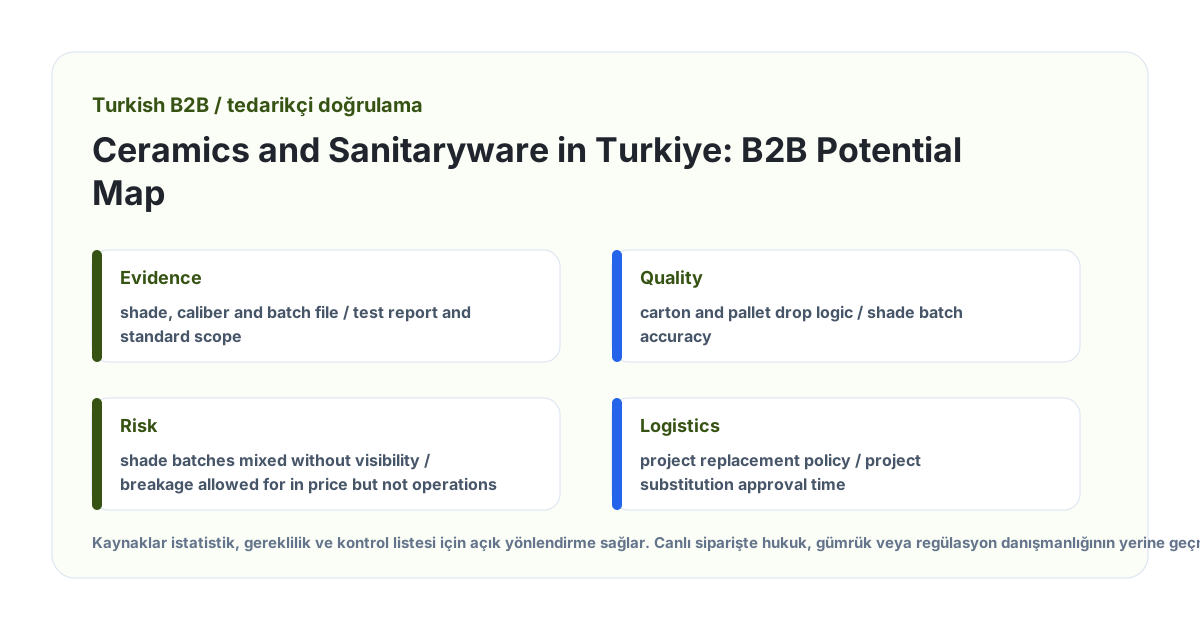
- shade, caliber and batch file
- test report and standard scope
- carton and pallet drop logic
- project replacement policy
- test report scope
- batch, shade or quarry record
- pallet and crate plan
- project substitution rule
- replacement policy
- legal entity and production-site confirmation
Sourcing decision matrix
The decision matrix is intentionally practical. It helps a buyer avoid the common mistake of treating a responsive sales contact as a qualified supplier. A candidate should move forward only when the evidence supports the product, the market and the first-order plan.
| Decision layer | What to evaluate | Go / no-go rule |
|---|---|---|
| Sector fit | Best for distributors, hotels, project buyers and retailers sourcing tiles, bathroom products, sinks and coordinated collections. | Proceed only if the product family matches a visible Turkish supplier cluster. |
| Evidence fit | test report scope; batch, shade or quarry record; pallet and crate plan | Proceed if documents are current, product-specific and owned by a named contact. |
| Quality fit | shade or finish approval; breakage allowance rule; project lot reservation | Proceed if release rules are written before production. |
| Logistics fit | Incoterm and named place; carton and pallet specification; HS code and origin file | Proceed if landed-cost assumptions are visible before purchase order. |
Risks that change the sourcing decision
Potential is not readiness. The buyer should pause, escalate or redesign the RFQ when any of these signals appear. A small issue during sampling often becomes a larger cost after production if the owner, evidence and correction deadline are unclear.
- shade batches mixed without visibility
- breakage allowed for in price but not operations
- project spec changes uncontrolled
- only a catalog is shared when production evidence is requested
- the supplier avoids naming the production site
- price changes when documentation is requested
- sample approval has no written rule for bulk production
How to move from interest to action
Create a one-page sector brief with product family, target market, expected order band, mandatory documents, inspection rule, delivery assumption and decision owner. Then compare at least two supplier answers against the same brief. Adjacent checks such as Ceramics and Sanitaryware in Turkiye: Supplier Shortlist and Verification and Ceramics and Sanitaryware in Turkiye: RFQ, Quality and Logistics Plan help keep market interest connected to verification and execution.
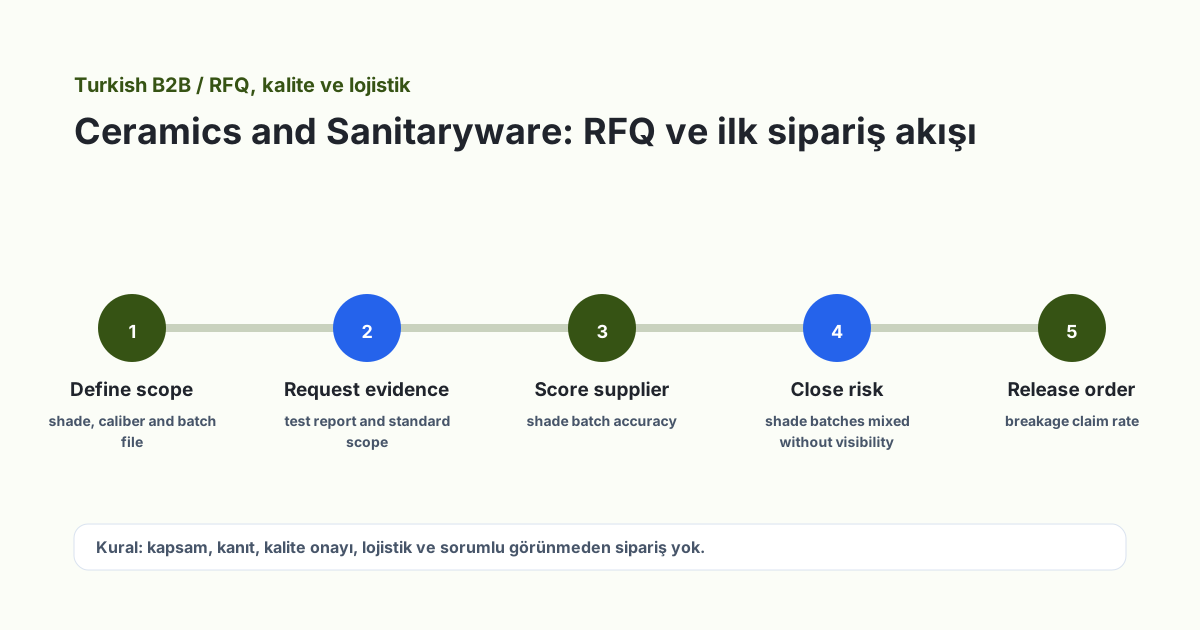
For Ceramics and Sanitaryware, frame the first order as a controlled potential map pilot: start with tiles and sanitaryware, define release evidence, keep logistics assumptions visible and review shade batch accuracy before repeat volume.
Buyer quality gate before action
Before using this Ceramics and Sanitaryware article as an RFQ or supplier file, check that every public-source note has been converted into a buyer decision, not copied as filler.
| Step | Evidence before price | Release rule |
|---|---|---|
| What buyers should define | Ceramics and Sanitaryware: tiles and sanitaryware; stone and marble; doors and profiles; insulation and boards | Start with product family, destination market, volume band, required evidence, packaging, Incoterm, payment milestones and order-release rule before comparing prices. |
| Evidence before price | shade, caliber and batch file; test report and standard scope; carton and pallet drop logic; project replacement policy; test report scope | Request product-specific evidence: production site, specification, sample approval, quality records, packaging plan, export document example and corrective-action owner. |
| Buyer risks to control | shade batches mixed without visibility; breakage allowed for in price but not operations; project spec changes uncontrolled; only a catalog is shared when production evidence is requested; the supplier avoids naming the production site | Control vague specification, hidden production responsibility, sample-to-bulk drift, weak packaging, missing documents and unverified payment details. |
| RFQ and first-order workflow | For Ceramics and Sanitaryware, frame the first order as a controlled potential map pilot: start with tiles and sanitaryware, define release evidence, keep logistics assumptions visible and review shade batch accuracy before repeat volume. | Rule: no order before scope, evidence, quality release, logistics and owner are visible. |
Ceramics and Sanitaryware supplier action
Use the guide as the buyer file, then request a shortlist or submit an RFQ with the evidence already defined: shade, caliber and batch file, test report and standard scope, carton and pallet drop logic.
FAQ
Is Turkiye a good sourcing base for Ceramics and Sanitaryware?
It can be a strong option when the buyer needs tiles and sanitaryware, stone and marble, doors and profiles and can verify supplier evidence before price comparison. National data should be used for sector context, while product-specific supplier documents should drive approval.
Which Ceramics and Sanitaryware product groups should buyers map first?
Start with tiles and sanitaryware, stone and marble, doors and profiles, insulation and boards, project material packages. Narrow product families create better supplier answers than broad sector inquiries.
What evidence matters most before contacting Ceramics and Sanitaryware suppliers?
Ask first for shade, caliber and batch file, test report and standard scope, carton and pallet drop logic, project replacement policy, test report scope. These records show whether the supplier understands repeatable B2B supply, not only sales presentation.
Should buyers use Turkey or Turkiye in search and sourcing documents?
Use both where useful. Turkey still appears in many buyer searches, while Turkiye is the official modern country name. The operating file should be clear, consistent and understandable to suppliers, brokers and internal teams.
Related buyer paths across the network
Official and open sources
Ceramics and Sanitaryware in Turkiye: B2B Potential Map is original. It does not copy competitor websites, closed market reports or supplier-directory prose. The sources below are used as official or open references for Ceramics and Sanitaryware interpretation and checklist design.
For the potential map angle, these links support national context, product-requirement thinking and verification workflow design. They do not replace buyer-side legal, customs or regulatory advice for a live Ceramics and Sanitaryware order.
- World Bank Enterprise SurveysPublic/open-data reference for business-environment and firm-level questions.
- TurkStat - Annual Industry and Service Statistics, 2024Official statistics used for production-value and sector-structure context.
- GOV.UK - Product safety advice for businessesOpen Government Licence public-sector guidance for product-safety workflow design.
- World Bank Logistics Performance IndexOpen/public logistics-performance reference for shipment and customs planning.
- Republic of Turkiye Ministry of Trade - Foreign Trade Data Bulletin, December 2025Official public bulletin used for national goods-export and trade-volume context.
- TurkStat - Foreign Trade Statistics, December 2024Official statistics used for export composition and general trade-system context.
- TurkStat - External Trade Statistics by Enterprise Characteristics, 2024Official statistics used for exporter-size mix and buyer qualification logic.
- World Bank Data Catalog - public licensesOpen-license reference for World Bank datasets, including CC BY style reuse where stated.
Related sector reading
- Ceramics and Sanitaryware in Turkiye: Supplier Shortlist and Verification
- Ceramics and Sanitaryware in Turkiye: RFQ, Quality and Logistics Plan
- Ceramics and Sanitaryware: Supplier Regions, Chambers and Export Channels
- Ceramics and Sanitaryware Product Families: tiles and sanitaryware, stone and marble
- Ceramics and Sanitaryware in Turkiye: Import Compliance, HS Codes and Document Control
- Ceramics and Sanitaryware in Turkiye: Landed Cost, MOQ and Negotiation Playbook