Electrical and Electronics: Supplier Regions, Chambers and Export Channels exists because a real sourcing search is not only a keyword search. Buyers need to understand where supplier conversations may start, which public institutions can provide context, and which signals are useful without mistaking them for supplier qualification.
This article reads Electrical and Electronics through official statistics, exporter-organization context, organized industrial zone references, chamber-style capacity signals and municipal open data where it helps route and infrastructure thinking. It does not publish scraped company lists, private market-report prose or unverified supplier claims.
What regional sourcing can and cannot prove
Regional information can show where to look, how to plan visits, which logistics questions to ask and which institutions may understand the sector. It cannot prove that a specific supplier is ready for the buyer's product, destination market or first order. That proof still needs documents, samples, quality records and shipment evidence.
| Signal | Open or official source type | Buyer use |
|---|---|---|
| Official statistics | TurkStat, Ministry of Trade, CBRT and public trade datasets. | Use them to test whether Electrical and Electronics has enough national and sector context to justify deeper supplier work. |
| Exporter organizations | TİM and relevant exporter associations. | Use them for export-channel language, fair/delegation signals and sector context; do not treat membership as supplier approval. |
| Chambers and capacity signals | TOBB capacity-report statistics, chambers and organized industrial zone references. | Use these signals to frame production depth around cables and harnesses, panels, lighting products. |
| Municipal and regional open data | Metropolitan municipality open data and regional logistics context. | Use for port, road, warehouse, urban and labor-market orientation; never as proof of product quality. |
| Product and market requirements | EU Access2Markets, GOV.UK, FDA/USDA/NIST/CISA and similar public guidance. | Use for checklist design and destination-market questions before sending the RFQ. |
Where the first search should be tested
The regions below are not a ranking and they are not a directory. They are practical starting points for a buyer who wants to turn public context into a shortlist conversation. Each regional probe should be tested with the same evidence request so geography does not become a substitute for due diligence.
| Regional probe | Product angle | First proof request | Risk to control |
|---|---|---|---|
| Istanbul and Marmara for export coordination | cables and harnesses | bill of materials control | substitution not controlled |
| industrial Anatolian clusters for flexible manufacturing | panels | incoming component traceability | test evidence not linked to serial or lot |
| port-linked corridors for containerized orders | lighting products | electrical test record | certification scope misunderstood |
Exporter associations and professional organizations
Exporter associations, chambers and sector bodies are useful because they speak the language of trade flows, fairs, delegations and member ecosystems. They are especially useful when a buyer is trying to learn which questions are normal for the category. They are not a guarantee that a member company can pass the buyer's audit or ship the exact SKU.
For Electrical and Electronics, read association material as context for cables and harnesses, panels, lighting products, electronic assemblies. Then move from public context to supplier-specific proof: bill of materials control, incoming component traceability, electrical test record, destination safety and label review, BOM freeze.
Municipal and local open data
Municipal open data is useful for the operating side of sourcing: transport corridors, warehouse density, city infrastructure, port-adjacent movement, labor-market orientation and visit planning. It should never be used to claim that a supplier is verified. A municipality can help a buyer understand place; the supplier file must still prove product and process.
| Local signal | How to use it | How not to use it |
|---|---|---|
| Transport and port access | Estimate route questions, delivery windows and visit plans. | Do not infer quality or export readiness from proximity alone. |
| Industrial or commercial density | Prioritize where to ask chambers, OIZs and associations for context. | Do not publish a supplier claim unless the company itself verifies it. |
| Workforce and city data | Plan audit travel, support availability and service windows. | Do not treat labor-market context as compliance evidence. |
Open-source research checklist
The buyer should keep a research log that separates fact, source and interpretation. A public statistic can be quoted as context. A public association page can be used as sector orientation. A supplier claim should be treated as a lead until it is confirmed with documents.
- Record the source used for each Electrical and Electronics market assumption.
- Tag each note as official statistic, open data, association context, public guidance or supplier-provided evidence.
- Avoid closed market-report claims unless the buyer has a license and can cite them internally.
- Do not copy directory descriptions; rewrite the buyer interpretation from the source and the RFQ need.
- Ask whether the regional signal actually changes cables and harnesses supplier selection or only adds background.
Questions to ask chambers, OIZs and associations
A professional body should not be asked to approve a supplier for the buyer. The better request is narrower: ask for sector context, typical documentation, trade-fair signals, export categories, relevant regional clusters and whether the buyer should speak to a specialized association before contacting companies.
| Question | Why it matters | Follow-up proof |
|---|---|---|
| Which Electrical and Electronics product families are common in your ecosystem? | Separates real sector depth from broad national claims. | cables and harnesses; panels; lighting products |
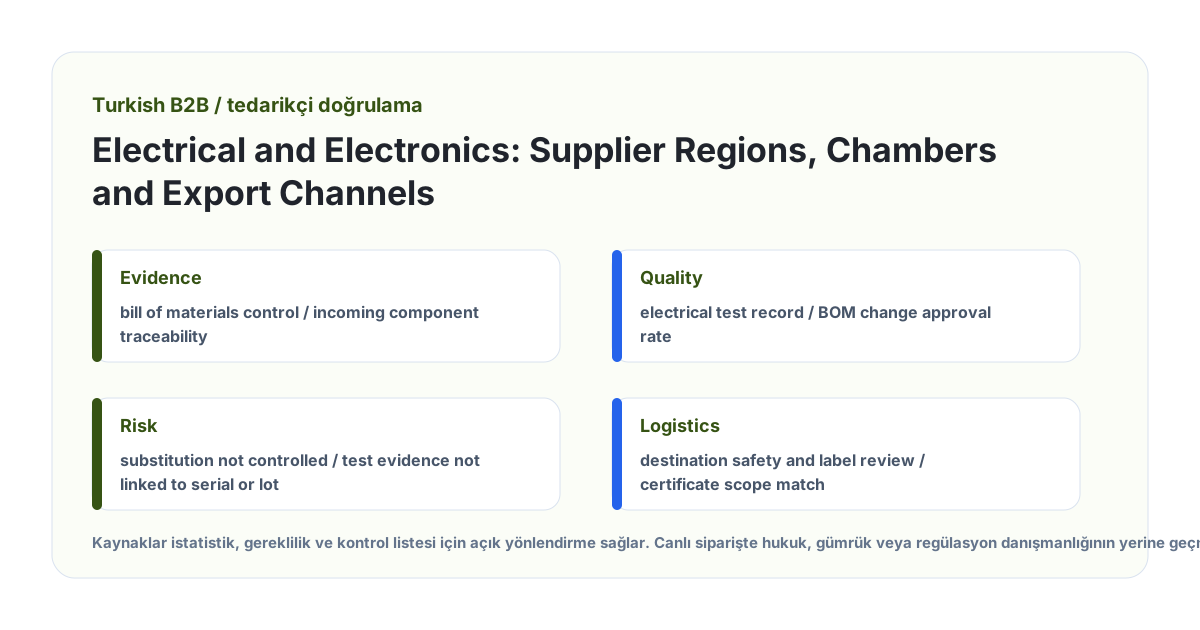
| Which documents are normally requested by foreign buyers? | Shows whether the buyer checklist is realistic. | bill of materials control; incoming component traceability; electrical test record |
| Which regions or fairs are most relevant? | Improves visit planning and supplier discovery. | Istanbul and Marmara for export coordination; industrial Anatolian clusters for flexible manufacturing |
| Which claims should a buyer verify independently? | Reduces the risk of association context being over-read. | substitution not controlled; test evidence not linked to serial or lot |
How to turn regional context into a shortlist
Use regional and institutional sources to design the search path, then use Electrical and Electronics in Turkiye: B2B Potential Map and Electrical and Electronics in Turkiye: Supplier Shortlist and Verification to qualify suppliers by evidence. The workflow is: source context, build a target list, send one evidence request, compare answers, then decide whether a site visit or sample makes sense.
- Central Bank of the Republic of Turkiye - manufacturing capacity utilization
- Invest in Turkiye - investment zones
- TOBB - Industrial Capacity Report Statistics
- Turkiye Exporters Assembly - export figures and exporter association context
- TurkStat - Annual Industry and Service Statistics, 2024
- GOV.UK - Product safety advice for businesses
- NIST Cyber Supply Chain Risk Management
Buyer quality gate before action
Before using this Electrical and Electronics article as an RFQ or supplier file, check that every public-source note has been converted into a buyer decision, not copied as filler.
| Step | Evidence before price | Release rule |
|---|---|---|
| What buyers should define | Electrical and Electronics: cables and harnesses; panels; lighting products; electronic assemblies | Start with product family, destination market, volume band, required evidence, packaging, Incoterm, payment milestones and order-release rule before comparing prices. |
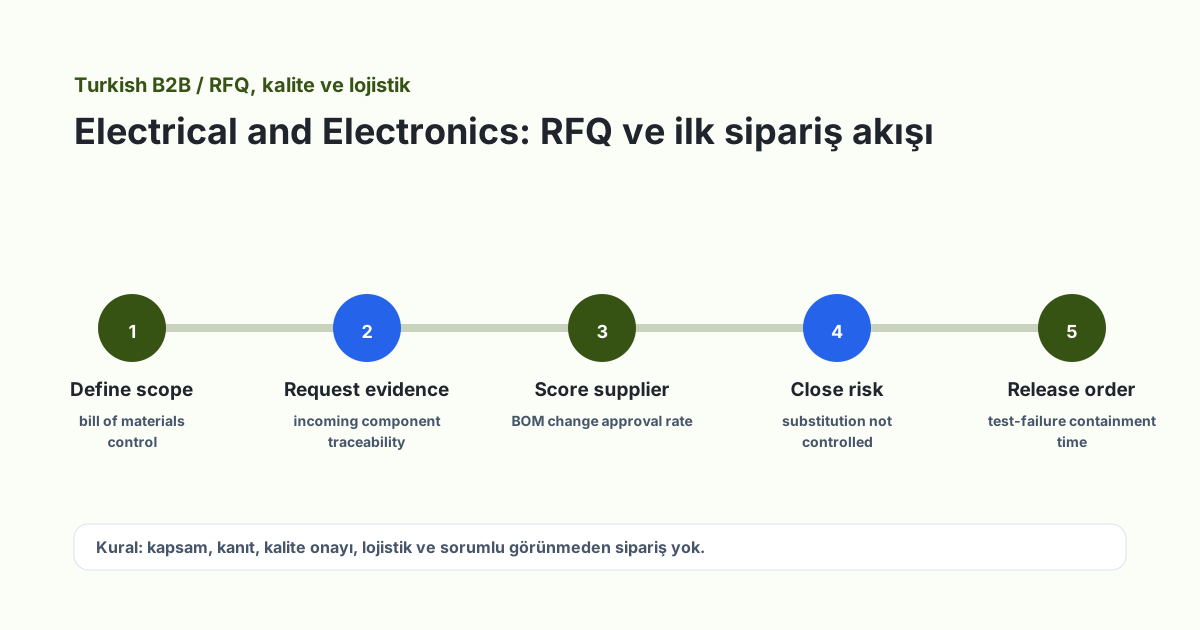
| Evidence before price | bill of materials control; incoming component traceability; electrical test record; destination safety and label review; BOM freeze | Request product-specific evidence: production site, specification, sample approval, quality records, packaging plan, export document example and corrective-action owner. |
| Buyer risks to control | substitution not controlled; test evidence not linked to serial or lot; certification scope misunderstood; a certificate covers a family but not the quoted model; component substitutions are treated as purchasing decisions only | Control vague specification, hidden production responsibility, sample-to-bulk drift, weak packaging, missing documents and unverified payment details. |
| RFQ and first-order workflow | For Electrical and Electronics, frame the first order as a controlled region and channel map pilot: start with cables and harnesses, define release evidence, keep logistics assumptions visible and review BOM change approval rate before repeat volume. | Rule: no order before scope, evidence, quality release, logistics and owner are visible. |
Electrical and Electronics supplier action
Use the guide as the buyer file, then request a shortlist or submit an RFQ with the evidence already defined: bill of materials control, incoming component traceability, electrical test record.
FAQ
Can regional data verify a Electrical and Electronics supplier?
No. Regional data can show where to look and which institutions may understand the sector, but supplier approval still requires product-specific evidence such as bill of materials control, incoming component traceability, electrical test record, destination safety and label review.
Which institutions are useful for Electrical and Electronics sourcing context?
Use official statistics, exporter organizations, chambers, organized industrial zone references and municipal open data for context. Treat each source as orientation, not as a substitute for supplier due diligence.
How should buyers use municipality open data?
Use it for logistics, infrastructure, visit planning and local operating context. Do not use municipal data to claim product quality, compliance or supplier verification.
What should a buyer ask before visiting a regional cluster?
Ask which product families are common, which documents foreign buyers request, which fairs or associations matter and which claims should be verified independently.
Related buyer paths across the network
Official and open sources
Electrical and Electronics: Supplier Regions, Chambers and Export Channels is original. It does not copy competitor websites, closed market reports or supplier-directory prose. The sources below are used as official or open references for Electrical and Electronics interpretation and checklist design.
For the region and channel map angle, these links support national context, product-requirement thinking and verification workflow design. They do not replace buyer-side legal, customs or regulatory advice for a live Electrical and Electronics order.
- Turkiye Exporters Assembly - export figures and exporter association contextExporter-organization public information used for sectoral export-channel and association-context reading.
- TOBB - Industrial Capacity Report StatisticsOfficial Statistics Program reference for industry capacity-report statistics and production-base interpretation.
- Invest in Turkiye - investment zonesOfficial investment-promotion reference for organized industrial zones, technoparks and production-location context.
- Republic of Turkiye Ministry of Trade - list of organized industrial zonesOfficial public list used to frame OIZ-based regional search without treating location as supplier approval.
- Istanbul Metropolitan Municipality - Open Data PortalMunicipal open-data reference for city, transport and infrastructure context; not a supplier-quality source.
- Izmir Metropolitan Municipality - Open Data PortalMunicipal open-data reference for local infrastructure and logistics context where relevant.
- Central Bank of the Republic of Turkiye - manufacturing capacity utilizationOfficial real-sector statistics reference for capacity-cycle and manufacturing operating context.
- TurkStat - Annual Industry and Service Statistics, 2024Official statistics used for production-value and sector-structure context.
- GOV.UK - Product safety advice for businessesOpen Government Licence public-sector guidance for product-safety workflow design.
Related sector reading
- Electrical and Electronics in Turkiye: B2B Potential Map
- Electrical and Electronics in Turkiye: Supplier Shortlist and Verification
- Electrical and Electronics in Turkiye: RFQ, Quality and Logistics Plan
- Electrical and Electronics Product Families: cables and harnesses, panels
- Electrical and Electronics in Turkiye: Import Compliance, HS Codes and Document Control
- Electrical and Electronics in Turkiye: Landed Cost, MOQ and Negotiation Playbook